


How to Ask for the Haircut You Want When You Don't Know the Terminology

Sitting in the salon chair can feel strangely high-pressure when you know what you want, but not how to say it. You might have a picture in your head, a saved image on your phone, or just a feeling of “I want it lighter”, “I need more shape”, or “please don’t take too much off”.
That is enough.
You do not need to speak like a hairdresser to get a haircut you love. A good stylist would rather hear your real words than watch you struggle to use terms you are not sure about. The consultation is there to translate your ideas into a cut, colour, or style that works for your hair.
If you have ever searched What to ask for your hair appointment because you were worried about saying the wrong thing, this guide is for you.
Start with the result, not the technical term
You do not have to ask for a “textured lob”, “graduated layers”, or a “soft curtain fringe” if those words do not feel natural. Start with what you want the haircut to do.
Try saying:
“I want my hair to feel less heavy.”
“I want more movement when I wear it down.”
“I want it to look neater without losing much length.”
“I want my curls to sit better around my face.”
“I want something that still looks good when I air dry it.”
These sentences tell your stylist far more than a guessed technical term. They explain the problem and the goal.
If you say, “I think I want layers,” your stylist may ask what kind. If you say, “My hair feels flat at the top and bulky at the ends,” they can suggest the right type of layers, shaping, or weight removal.
The language does not need to be perfect. It just needs to be honest.
Bring pictures, but explain what you like about them
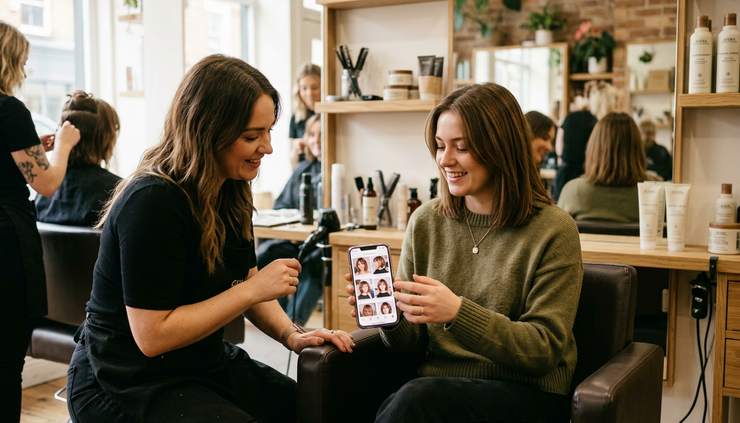
Photos are one of the best tools you can bring to a hair appointment. They give your stylist a visual starting point and reduce the chance of misunderstanding.
The key is to explain what you like about each image.
For example:
“I like the length in this photo.”
“I like the softness around the face.”
“I like the colour, but I don’t want it that bright.”
“I like the shape, but I want my fringe longer.”
“I like that it looks undone rather than too styled.”
It also helps to bring photos of what you do not want. This is especially useful if you have strong dislikes. Maybe you do not like blunt ends, short layers, a heavy fringe, or too much volume at the sides.
A stylist can learn a lot from “not that” as well as “like this”.
One thing to remember, though: inspiration photos often show hair that has been styled, curled, blow-dried, filtered, or photographed in ideal light. Your stylist can explain what is realistic for your hair type and routine.
Say how much time you spend on your hair
The best haircut is not just the one that looks good when you leave the salon. It needs to work on a normal Tuesday morning when you have five minutes, a hairbrush, and maybe a bit of product.
Tell your stylist how you usually wear your hair.
Useful details include:
How often you wash it
Whether you blow-dry, diffuse, straighten, curl, or air dry
How much product you like using
Whether you tie it up for work, exercise, or comfort
How often you are willing to come back for trims
Whether you want a high-maintenance or low-maintenance style
If you love styling your hair, say so. If you want to do almost nothing to it, say that too. There is no wrong answer.
A fringe, short crop, bright blonde, sharp bob, or heavily layered cut may look amazing, but some styles need more upkeep than others. Your stylist can guide you towards something that fits your life, not just the photo.
Be clear about length and your comfort zone
A small trim means different things to different people. To one person, it means half a centimetre. To another, it means several centimetres of dry ends.
Instead of saying “just a trim”, show the amount with your fingers or point to where you want the hair to sit.
You can say:
“I’m comfortable losing this much.”
“Please keep it below my shoulders.”
“I still need to tie it up.”
“I want the ends healthier, but I’m nervous about losing length.”
“Can we take it shorter in stages?”
That last question is a good one if you are making a big change. Many stylists are happy to cut gradually, check in, and then take more off if you feel ready.
If you have had a bad experience before, mention it. You do not need to make it awkward. A simple, “I’m a bit nervous because I’ve had too much taken off in the past,” helps your stylist understand why reassurance matters.
Use everyday words for shape, texture, and feel
Hair terminology can be confusing because the same word can mean different things depending on hair type, cut, and styling. Everyday descriptions are often clearer.
Instead of trying to guess the right phrase, describe what you want to see or feel.
If you are thinking this | You could say this |
My hair feels bulky | “Can we remove some weight without making it look thin?” |
I want movement | “I’d like it to fall with more shape rather than sit in one block.” |
I want face framing | “Can we add shorter pieces around my face, but keep them soft?” |
I want layers | “I want some shape, but I don’t want lots of short pieces.” |
I want a fringe | “I’m interested in a fringe, but I’d like to know what would suit my hair.” |
I hate blunt ends | “Can the ends look softer instead of very straight across?” |
This is the heart of What to ask for your hair appointment if you don't know the terminology. Describe the issue, the feeling, and the finish. Your stylist can handle the technical side.

Ask questions during the consultation
A good consultation should feel like a conversation, not a test. If your stylist uses a word you do not know, ask them to explain it.
You can ask:
“What does that mean for my hair?”
“Will that make it look shorter?”
“Will it need styling every day?”
“How will it grow out?”
“Can you show me where the shortest piece will be?”
“What would you recommend for my hair texture?”
These questions are normal. They do not make you difficult. They show that you care about the result.
It is also fine to pause before the cut starts and say, “Can we just confirm the plan?” A clear recap helps both of you feel confident.
Try this simple salon script
If you freeze in the chair, use this as a starting point:
“I’m not sure of the right words, but I know I want my hair to feel [lighter / softer / healthier / more shaped]. I like this part of the photo, especially [length / fringe / layers / colour / movement]. I don’t want [too short / too blunt / too much maintenance]. I usually style my hair by [air drying / blow-drying / tying it up]. What would you suggest for my hair?”
That gives your stylist enough to work with. It also opens the door for their professional advice.
The right words are helpful, but they are not required
Hair appointments should not feel intimidating. You are allowed to ask for what you want in normal language. You are allowed to bring photos, ask questions, say what you dislike, and admit that you do not know the terminology.
The best results often come from a clear conversation, not perfect vocabulary.
Next time you sit in the chair, focus on these five things: what you like, what you do not like, how much length you want to keep, how you style your hair, and how you want the finished cut to feel. Your stylist can translate the rest.


Comments